

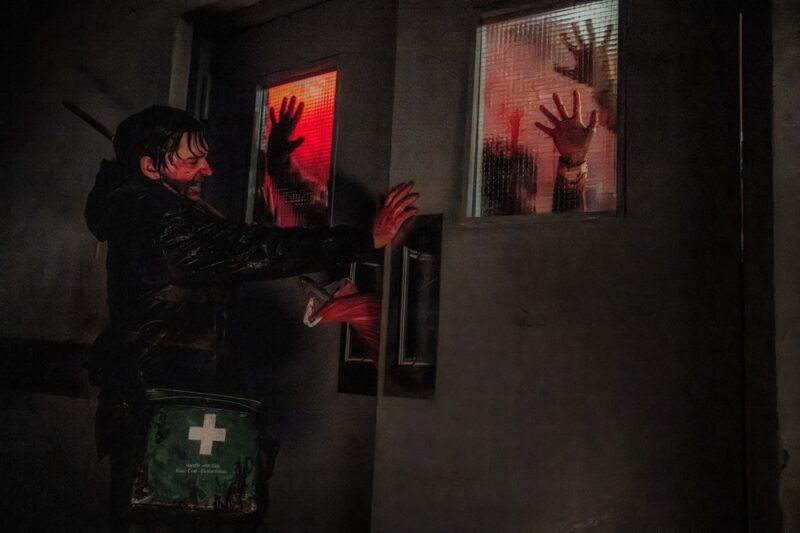
The most inspired decision Zach Cregger makes with Resident Evil is also, on paper, one of the strangest: he doesn’t particularly seem interested in making a Resident Evil movie. At least not in the traditional adaptation sense. There’s no slavish recreation of a beloved game narrative, no parade of familiar characters waiting for applause, and little concern for forcing decades of mythology into something digestible for the uninitiated. Instead, Cregger has made a film about what it feels like to play Resident Evil – specifically when you’re not especially good at it.
That distinction proves crucial to why this latest cinematic resurrection of the Capcom juggernaut is such ridiculous fun.
Our designated player-character is Bryan (Austin Abrams), a medical courier whose increasingly terrible day begins innocently enough with one last delivery. He’s offered some extra money to transport a high-priority package to Raccoon City, a destination whose name naturally carries considerably more menace for the audience than it does for Bryan. With a snowstorm making the journey increasingly treacherous, his drive is interrupted when a woman suddenly appears in front of his car. Bryan, being a fundamentally decent person, decides to take the injured stranger with him.
Anyone remotely familiar with Resident Evil can probably appreciate what a spectacularly poor decision that turns out to be.
From there, Cregger and co-writer Shay Hatten construct Resident Evil almost like a series of increasingly deranged levels. Bryan moves through isolated buildings, tunnels, sewers, streets and medical facilities, encountering progressively more grotesque mutations while gradually acquiring increasingly powerful weaponry. There are doors that refuse to cooperate (the film’s running gag of anything being specifically padlocked is particularly humorous), moments of temporary sanctuary, objects whose usefulness becomes apparent much later, and monsters that appear with precisely the timing required to make you wish Bryan would stop staring at them and run.
It’s remarkably simple storytelling, but that simplicity is part of the pleasure. After the elaborate narrative constructions of Barbarian and Weapons, Cregger strips his latest film down to forward momentum: get Bryan to Raccoon City, preferably with most of his limbs still attached.
And Bryan is exactly the type of protagonist this approach needs. Abrams has already demonstrated an ability to locate comedy in panic and discomfort, but Resident Evil gives him virtually an entire film to weaponise it. Bryan isn’t secretly an action hero waiting for catastrophe to unlock his potential. He misses shots. He freezes. He makes questionable decisions. He swears at situations that have moved well beyond the usefulness of profanity. Even as he becomes marginally more capable, there remains something reassuringly ordinary about him.
Abrams understands that the joke isn’t that Bryan is stupid; it’s that he reacts approximately how most people would when confronted with an organism composed of entirely too many human appendages.
It creates an unusually participatory quality too. Watching Bryan navigate Raccoon City can feel remarkably similar to watching a friend play a horror game badly. You know the experience: everyone suddenly becomes an expert from the safety of the couch. Don’t go through that door. Pick up the gun. The gun, Bryan. Stop looking behind you. Actually, look behind you. RUN.
Cregger knowingly encourages that relationship between audience and protagonist. There’s an almost mischievous rhythm to how Bryan repeatedly enters spaces we instinctively know are terrible ideas, and the film frequently uses the grammar of gaming without turning itself into an exhausting exercise in imitation. Occasional perspectives evoke the sensation of controlling a character; environments function like distinct stages; weapons arrive with the satisfaction of an upgrade; and certain obstacles obey the wonderfully nonsensical logic anyone who has ever screamed at an apparently indestructible video-game padlock will immediately understand.
The references are there for devotees, but crucially they aren’t homework. Cregger understands that recognising something and enjoying something are two entirely different pleasures.
He also remembers something that Hollywood’s previous attempts at Resident Evil have occasionally lost amid all the mythology: this world is inherently fucking ridiculous.
And this Resident Evil is very funny.
Not quippy, self-satisfied blockbuster funny, where characters appear contractually obligated to puncture every frightening moment with a joke, but funny because Bryan’s very human behaviour keeps colliding with increasingly inhuman circumstances. Cregger lets the absurdity emerge naturally from panic, timing and escalation. A moment can be genuinely revolting and hilarious almost simultaneously, and some of the film’s most elaborate deaths land somewhere between a wince and a laugh of disbelief; perhaps the best example of this being a sequence in a seemingly abandoned camper van.
That tonal balancing act is particularly useful because Cregger certainly hasn’t softened the material. Resident Evil is gloriously disgusting when it wants to be. Bodies rupture, mutate and reorganise themselves into configurations that suggest human anatomy has become merely a loose recommendation. The creature work embraces the franchise’s penchant for increasingly obscene biological nightmares, and there’s a tactile nastiness to much of the violence that keeps the film from becoming visually anonymous.
One particularly inspired sequence involving Bryan, a street and threats positioned high above him is Cregger operating at his most gleefully sadistic. It’s the kind of set-piece where you understand what is about to happen a fraction of a second before it does, only for the execution to become considerably more excessive than whatever your brain had prepared for. Disgust gives way to laughter, which gives way to further disgust.
At a brisk 90-or-so minutes, there’s barely enough time to recover before Bryan is shoved towards his next nightmare. Cinematographer Dariusz Wolski gives the journey a suitably oppressive texture, particularly through the snowbound opening stretches and the increasingly hostile interiors, whilst Joe Murphy’s editing keeps the film moving without making its action incoherent. There’s an appealing geography to Bryan’s ordeal; for all the chaos, you feel as though you’re travelling through this nightmare alongside him.
The relentless structure does come with a cost. Because Bryan spends so much of the film alone, the supporting characters are necessarily fleeting, and certain emotional ideas never receive enough oxygen to resonate as strongly as they might. His personal life gives the story something resembling an emotional destination beyond simply surviving, but as the monsters become bigger and the film grows louder, that thread becomes less compelling.
Paul Walter Hauser’s Carl, an Umbrella Corporation scientist Bryan encounters along the way, only emphasises what’s missing. Hauser and Abrams immediately spark off each other, and their contrasting energies briefly suggest an alternate version of Resident Evil as an extremely fucked-up buddy comedy. Their scenes are so enjoyable that Carl’s presence almost becomes frustrating simply because you want more of it.
The film’s escalation is also marginally less effective than its comparatively contained first half. As practical grotesquerie increasingly gives way to larger visual-effects spectacle, some of the intimacy that makes Bryan’s earlier encounters so unnerving is lost. Cregger is better when something horrible is occupying the same cramped space as his protagonist than when the film is attempting to overwhelm him – and us – through sheer scale.
But even when Resident Evil threatens to become another effects-heavy genre climax, there’s enough personality running through it to keep the machinery alive. Cregger may be working inside somebody else’s sandbox, but he never feels anonymous within it.
Perhaps that’s ultimately the smartest way to approach a property that has already survived multiple movies, television series, animated offshoots, reboots and enough wildly divergent interpretations to make the concept of definitive fidelity almost meaningless. Cregger doesn’t try to replace the games, nor does he merely dress a zombie movie in recognisable iconography. He takes the peculiar pleasures of playing them – the scarcity, the exploration, the escalating weaponry, the grotesque surprises, the nonsensical obstacles and, most importantly, the sheer panic of knowing you have made a terrible decision approximately three seconds after making it – and finds a cinematic language for them.
The result may lack the emotional ambition of Weapons or the structural audacity that announced Cregger as such an exciting horror filmmaker in the first place, but Resident Evil isn’t trying to be either of those movies. It wants to put you beside Bryan as everything goes spectacularly, disgustingly wrong.
And when an entire theatre is mentally grabbing the controller from his hands because surely we could survive Raccoon City better than this idiot, Cregger has understood the assignment better than any amount of faithful recreation ever could.
Resident Evil is nasty, breathless, frequently hilarious and knowingly absurd – a horror movie that understands sometimes the most faithful way to adapt a game isn’t to recreate its story. It’s to make you desperately want a turn.


THREE AND A HALF STARS (OUT OF FIVE)
Resident Evil is now screening in Australian theatres.
